




This website uses cookies so that we can provide you with the best user experience possible. Cookie information is stored in your browser and performs functions such as recognising you when you return to our website and helping our team to understand which sections of the website you find most interesting and useful.


Products
The products listed here are for overseas markets, not for Japan domestic.

- Information Equipment / Software
- Industrial PC
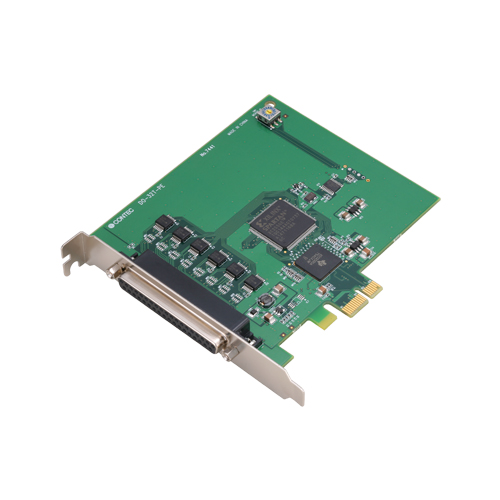
- CONTEC Digital Output PCI Express Card 32ch (Non-isolated 5VDC-TTL) DO-32T-PE
Opto-coupler isolated input (supporting current sink output) and opto-coupler isolated open-collector output (current sink type). Opto-coupler bus isolation
This product is a PCI Express bus-compliant interface card used to provide a digital output function on a PC. It features 32 unisolated open-collector outputs. Windows/Linux driver is bundled with this product. Possible to be used as a data recording device for LabVIEW, with dedicated libraries. You can develop a high application in a short term if You use collection of ActiveX components ACX-PAC(W32) for option software.
Digital Output PCI Express Card 32ch (Non-isolated 5VDC-TTL)
Model:
DO-32T-PE
Maker:
CONTEC Co., Ltd.
Features
- Unisolated open-collector output
It has the 32ch of unisolated open-collector output whose response speed is 200nsec. The output rating is max. 30VDC, 40mA per ch. - Windows/Linux compatible driver libraries are attached.
Using the attached driver library API-PAC(W32) makes it possible to create applications of Window/Linux. In addition, a diagnostic program by which the operations of hardware can be checked is provided. - Functions and connectors are compatible with PCI compatible card DO-32T2-PCI.
The functions same with PCI compatible card DO-32T2-PCI are provided. In addition, as there is compatibility in terms of connector shape and pin assignments, it is easy to migrate from the existing system. - Using the dedicated library VI-DAQ makes it possible to make a LabVIEW application.
Specifications
Add-on Module
| Series | |
|---|---|
| Bus Specification | PCI Express |
| Size | Short Size |
| Used Connector | D-SUB 37-pin (Female) |
Digital I/O
| Input Channels | – |
|---|---|
| Output Channels | 32-ch |
| Bi-directional I/O Channels | – |
| Response Time (Input) | – |
| Response Time (Output) | 200nsec (max.) |
| Operating Voltage (Input) | – |
| Operating Voltage (Output) | 5VDC-TTL |
| Input Circuit | – |
| Output Circuit | Non-isolated TTL open-collector output (Negative logic) |
| Built-in Power Supply | – |
Supported OS
| Supported OS | Windows 11 (64-bit); Windows 10 IoT Enterprise LTSC 2021 (64-bit); Windows 10 IoT Enterprise 2019 LTSC (64-bit); Windows 10 IoT Enterprise LTSB 2016 (64-bit); Windows 10 (64-bit); Windows 10 (32-bit); Windows 8.1 (64-bit); Windows 8.1 (32-bit); Windows 7 (64-bit); Windows 7 (32-bit); Windows Vista (64-bit); Windows Vista (32-bit); Windows XP (64-bit); Windows XP (32-bit); Windows 2000 (32-bit); Windows Server 2022; Windows Server 2019; Windows Server 2016 ; Windows Server 2012 R2; Windows Server 2008 (64-bit); Windows Server 2008 (32-bit); Windows Server 2003 (64-bit); Windows Server 2003 (32-bit); Linux |
|---|
* The supported OS differs depending on the software used for this product. For more details about supported OS and distribution, please refer to the software Readme or online help.
System specifications
| Item | Specifications | |
|---|---|---|
| Output | Type | Open Collector Output (Negative logic *1) |
| Number of Channels | 32ch (One common power supply per 16 channels) | |
| Output rated voltage | 30VDC (Max.) | |
| Output rated current | 40mA/channel (Max.) | |
| Response time | 200nsec within | |
| Common | External supply capable current | 5VDC 350mA(Max.) |
| Connecting distance | 1.5m(Typ.)(depending on wiring environment) | |
| I/O address | Any 32-byte boundary | |
| Interruption level | Not used | |
| Boards in one system | Maximum of 16 boards can be install in a same system. | |
| Power consumption | 3.3VDC 550mA(Max.) | |
| Bus specification | PCI Express Base Specification Rev. 1.0a x1 | |
| Dimension (mm) | 121.69(L)×110.18(H) | |
| Weight | 100g | |
*1 Data “0” and “1” correspond to the High and Low levels, respectively.
Related Article

To view the pdf files, the Adobe Reader from Adobe Systems is required.