



This website uses cookies so that we can provide you with the best user experience possible. Cookie information is stored in your browser and performs functions such as recognising you when you return to our website and helping our team to understand which sections of the website you find most interesting and useful.

ITEMLIST
Products Infomation

- Products by Category
- Automotive&EV
- NF Lock-In Amplifier/Preamplifier LI 5600 Series
High-Sensitivity Digital Lock-in Amplifier for Ultra-Low Signal Measurement
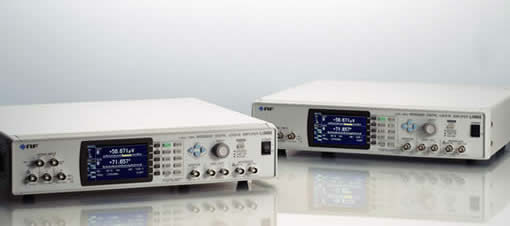
NF's newest lock-in amplifier LI5600 series is 2-phase, 2-frequency digital lock-in amplifier that delivers a high level of stability with post-phase detection digital signal processing. The series covers all areas of key functionality required for increasing reliability when measuring very small signals, such as an outstanding dynamic reserve up to 100 dB, update rates up to approximately 1.5 M samples/s (LI5660/LI5655), and smooth, high-speed 16-bit amplitude resolution output response.
The LI5660 series is equipped with the latest functions such as simultaneous 2-frequency measurements (except for LI5645) and subharmonic measurements to meet the needs for advance measurements in a wide range of applications and fields.
Features
• High-Response and High-Stability
• Up to 11 MHz with the wide-band, high-frequency input terminal (LI5660)
• Fractional Harmonic Measurements
• Dual-frequency Simultaneous Measurements
• Display and Sampling of Output Data
• External 10 MHz Synchronization
• Wide Range of Functions in a Thin, Compact Body
Applications
| SPM (Scanning Probe Microscope) Signal Processing
|
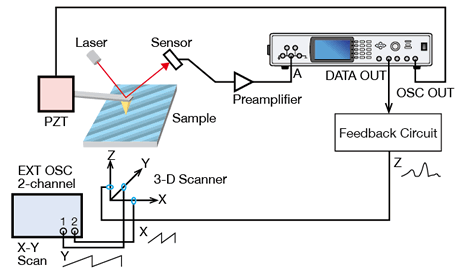
| Scanning probe microscopes such as STM (scanning tunnel microscope) and AFM (atomic force microscope) use a nanoscale probe at the tip to scan the surface of a sample. The signal between the probe and the sample is detected to observe the electronic state and structure of the sample surface, as well as its physical and chemical properties.
Lock-in amplifiers are used to control the distance between the sample and probe.
The synchronization filter can drastically reduce phase detection output ripples, resulting in much higher quality images, generated at a faster speed.
Lock-in amplifiers are also used for signal processing such as modulation signal demodulation with KFM (surface potential microscope) as well as STM and ATM.
|
| Light Transmission Measurements (Suppression of Illuminant Fluctuation)
|
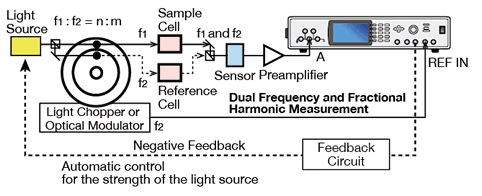
| Using both the dual-frequency simultaneous and fractional harmonic measurement functions allows fluctuation corrections of light sources and other sources using the dual beam method (ratio measurement) with a single LI5660/ LI5655/LI5650.
Applying negative feedback to the reference cell signal also stabilizes the strength of the light source.
The 10 MHz synchronization function can also be used to synchronize operation with external signal generators, allowing detection of any two frequencies.
|
| Hall Coefficient Measurement (Difference Frequency Measurement)
|
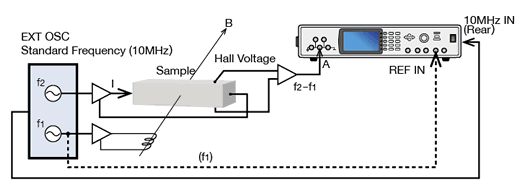
| The hall voltage is proportional to the product of two signals (current and magnetic field), and its frequency is the difference frequency (and sum) of the two signals. Synchronizing an external signal source, which generates a current and magnetic field, with the LI5600 series at an external 10 MHz allows measurement of the difference frequency signal of any two frequencies without having to arrange an external reference signal (difference frequency). (when used with a signal generator with a 2-channel output and frequency reference output)
If the original frequency is a integral* ratio, the fractional harmonic measurement function can also be used to measure the difference frequency signal. Either method avoids crosstalk interference from the external reference signal.
|
Other applications
• Spectroscopy (material science using Auger electron spectroscopy, photoacoustic spectroscopy, Raman spectroscopy, etc.)
• Measurement of optical properties (intensity, absorption, scattering, transmission, etc.)
• Optical application measurements (optical gyro, detection of distance, speed, vibration, etc.)
• Magnetic measurements (evaluation of magnetic materials, vibration-type magnetometer, magnetic detection using SQUID)
• Evaluation of various sensors (measurements of physical quantities detected by optical, magnetic, and piezoelectric elements, chemical changes, etc.)
• Null detection with impedance bridge
• Impedance measurements (minute impedance, minute capacity, chemical impedance)
• Thermal diffusivity measurement of thin film materials
• Inelastic Electron Tunneling Spectroscopy (IETS Methos)
• Measurement of TMR (Tunnel Magneto Resistance Effect)
Specifications
| LI5660 | LI5655 | LI5650 | LI5645 | |
| Frequency response | 0.5Hz to 11MHz | 0.5Hz to 3MHz | 1mHz to 250kHz | |
| Time constants setting |
1µs to 50ks | 5µs to 50ks | ||
| Voltage input sensitivity |
10nV to 10V | 10nV to 1V | ||
| Current input sensitivity |
10fA to 1µA | – | ||
| Frequency measurement |
Dual | Single | ||
| Phase measurement | Dual | |||
- Input noise: 4.5nV / √Hz
- Dynamic reserve: 100 dB or more
- Harmonic measurement: Up to 63rd order, with fraction setting
- Measurement parameters: X, Y, R, θ, DC, Noise
- Analog output: Outputs 4 selected from measurement parameters
- Data memory: Temporarily store measurement data in 3 memory buffers
- Remote control: USB, RS-232, GPIB, LAN

To view the pdf files, the Adobe Reader from Adobe Systems is required.